

Why Construction Training Programs Are Not Producing Job-Ready Graduates

At a Glance
- Most construction graduates complete their programs without the job-ready skills contractors actually need.
- The gap is not just about technical skills. It comes down to how credentials are structured, tracked, and verified.
- Training organizations rarely measure placement outcomes, making it hard to know what is or is not working.
- Contractors increasingly require verified, up-to-date credentials before hiring. Paper certificates and self-reported skills do not hold up.
- The fix requires training organizations to close the loop between certification, employer visibility, and continuous skill development.
- Digital credential systems can bridge the gap between training completions and actual job placements.
Introduction: Why Construction Graduates Are Not Job-Ready
Construction is one of the few industries where demand for skilled labor consistently outpaces supply. Open positions go unfilled for months. Projects run behind schedule. Contractors scramble to find workers who can show up and get to work on day one.
And yet, thousands of graduates leave construction training programs every year without getting placed.
This is not a talent shortage. It is a systems problem. And a large part of that problem starts inside the training organizations themselves.
Why Construction Graduates Are Not Getting Hired

Contractors do not hire based on course completion alone. What they need is evidence. They want to know that a candidate can perform a specific task, holds the right certifications for the job site, and that those credentials have been verified by a credible source.
When a graduate shows up with a printed certificate or a line on a resume, contractors have no fast, reliable way to check it. Many simply move on to candidates they have already worked with.
The hiring process in construction is built on trust, and trust requires verification. Without it, graduates from even strong construction training programs face an uphill battle, no matter how skilled they actually are.
There is also the classification issue. Many construction roles carry wage and safety compliance requirements, especially on union, prevailing wage, or government contracts. Hiring the wrong person for the wrong role without proper documentation exposes contractors to serious liability. This alone pushes them toward workers whose credentials can be confirmed quickly.
What Training Programs Are Missing Today
Most construction training programs are designed around a simple model: enroll students, deliver coursework, issue a certificate, and close the file. The problem is that this model ends at exactly the wrong moment.
Here is what is commonly missing:
Employer-aligned curriculum. Many programs are built around what instructors know how to teach, not around what employers need on the job site. The result is graduates who have completed coursework but lack the practical, role-specific skills that contractors are looking for.
Ongoing credential tracking. Certifications in construction expire. Safety licenses have renewal requirements. Trade qualifications change based on project type. Most training programs issue credentials once and have no mechanism to track renewals, lapses, or upgrades. Graduates are left on their own to manage this, and many do not.
Placement infrastructure. There is rarely a structured connection between the training organization and the contractors who could hire graduates. Some programs have informal relationships, but these do not scale. Without a systematic way to surface graduates to employers, placement becomes luck-dependent.
Outcome visibility. Ask most training programs what percentage of graduates got hired within six months of completing the course. Most cannot answer that question. Without placement data, programs have no feedback loop. They cannot tell what is working and what needs to change.
Why There Is a Gap Between Training and Employment
The gap between training completion and employment is not random. It follows a predictable pattern.
Training organizations operate on a one-time revenue model. A student pays for a course, completes it, and the relationship ends. There is no financial incentive built into this structure to care about what happens after graduation.
Employers, meanwhile, have moved toward credential verification as a baseline hiring requirement. With increasing regulatory pressure around worker classification, prevailing wage compliance, and site safety, contractors need documentation they can stand behind during an audit. A certificate issued by a training organization with no verification layer attached to it does not meet that bar.
This creates a mismatch. The training world measures inputs: enrollment numbers, course completions, and certifications issued. The employer world measures outputs: can this person do the job, and can I prove they are qualified if someone asks?
The two systems are not talking to each other, leaving graduates in the gap.
How Construction Training Can Improve Job Placement
Closing the gap does not require a complete overhaul of the curriculum. It requires training organizations to extend their roles beyond certification.
Connect credentials to employer networks. Graduates should be discoverable by contractors who are actively hiring. This means moving credentials out of PDF files and into systems that employers can actually search and verify. A training organization that can surface qualified, credentialed candidates directly to hiring contractors becomes a sourcing partner, not just an education provider.
Built-in credential lifecycle management. Training organizations should support graduates through renewals, continuing education, and certification upgrades. This extends the relationship, creates recurring revenue, and keeps graduate credentials current enough to be useful to employers.
Track placement outcomes. Programs that measure post-graduation employment rates can identify which credentials lead to hiring and which do not. This allows the curriculum to be adjusted based on real labor market demand rather than assumptions.
Engage contractors as curriculum partners. The organizations that hire graduates should have input into the training those graduates receive. Contractor feedback can shape course content, assessment standards, and the specific credentials that carry weight in hiring decisions.
How Verified Credentials Improve Job Readiness and Hiring Confidence
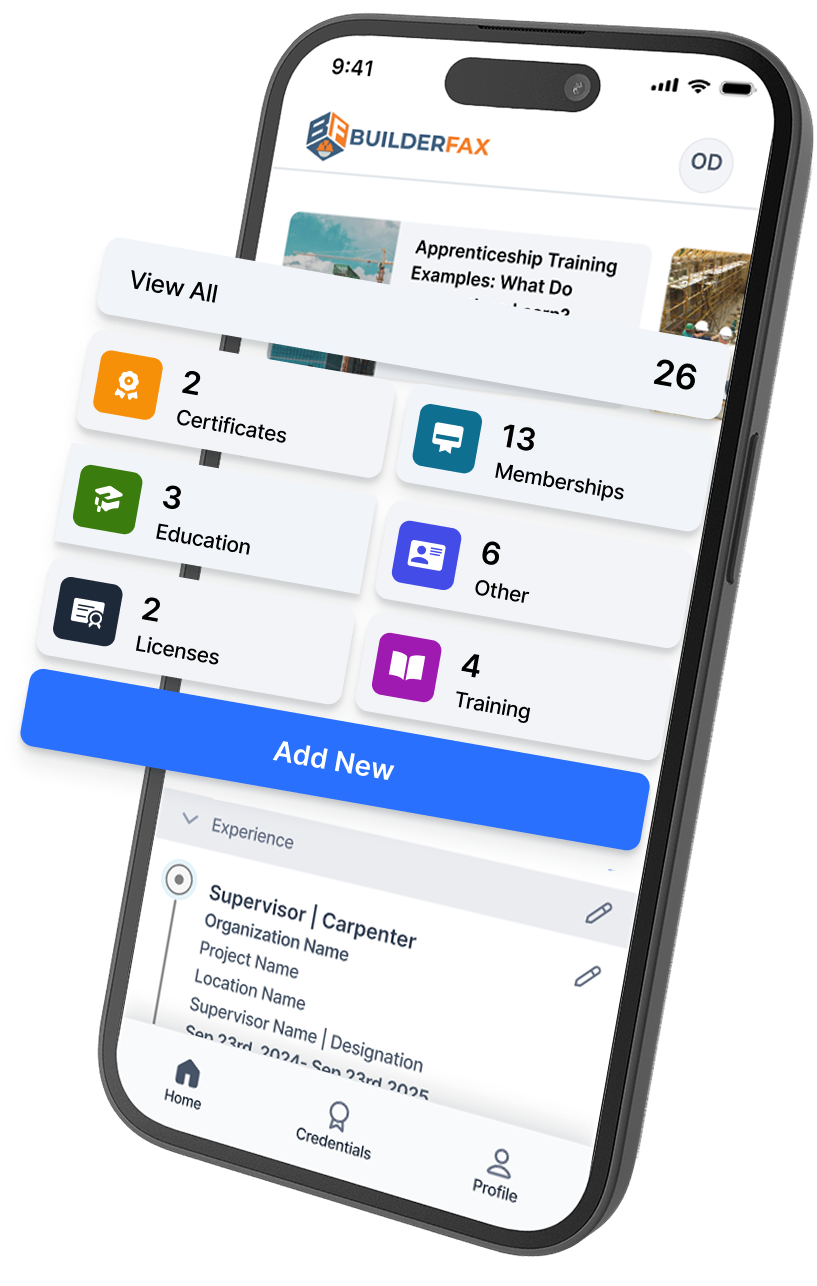
Verification is the piece that connects training to employment.
When a contractor can look up a candidate’s credentials in real time and confirm they are valid, current, and issued by a recognized body, the hiring decision becomes significantly easier. Verified credentials eliminate the back-and-forth of chasing paper documentation. They remove doubt about whether a certification is legitimate. And they reduce the compliance risk that makes contractors cautious about new hires.
For graduates, having verified digital credentials changes how they present themselves to employers. Instead of handing over paper or hoping a hiring manager takes their word for it, they can share a verified credential record that speaks for itself.
Platforms like BuilderFax are designed specifically for this. They give training organizations a way to issue credentials that are tied to a verifiable digital record. Contractors can check credentials instantly. Graduates carry a portable, verified profile that grows with their career. And training organizations become part of an ongoing employment ecosystem rather than a one-time transaction.
The effect on hiring confidence is significant. Contractors who can verify credentials before making an offer take on less compliance risk and make faster hiring decisions. Graduates who enter the job market with verified records get further in the process than those who do not.
This is what job readiness actually looks like in today’s construction hiring environment. It is not just about skills. It is about proving those skills in a format that employers trust.
Fixing Construction Hiring Requires Better Training and Verified Skills
The placement problem in construction is solvable. But it requires training organizations to rethink their role.
Issuing a certificate is not the end of the job. It is the beginning of the relationship between a graduate and the industry. The organizations that recognize this and build systems around it will produce graduates who actually get hired. They will also build something more durable: a reputation among contractors as a reliable source of qualified, verified workers.
The construction industry has no shortage of demand for skilled labor. What it lacks is a reliable bridge between where workers are trained and where they are needed. Better credential infrastructure, employer connectivity, and outcome tracking are not nice-to-haves. They are what separates a training program that places graduates from one that simply processes them.
Useful Resources
- OSHA Training and Certification Requirements for Construction
- U.S. Department of Labor Prevailing Wage Information
- NCCER Construction Workforce Credentials and Standards
- Bureau of Labor Statistics: Construction Occupational Outlook
- Associated Builders and Contractors Workforce Development Resources
- BuilderFax Credential Management Platform
Frequently Asked Questions
Why are construction graduates not job-ready after training programs?

.svg)
What is the main reason construction graduates struggle to get hired?
What are training programs missing in construction education?
What are verified skills in construction hiring?
How does lack of verification affect construction hiring?
Close the Gap Between Training and the Job Site
Download the BuilderFax app to store graduate credentials, certifications, and training records in one verified profile, giving employers instant access to confirmed qualifications and giving graduates a portable credential record that works from day one on the job.
Download BuilderFax.svg)
.svg)


.png)