

How Large EPC Firms Use Workforce Credential Management Across 5,000+ Workers

At a Glance
- Workforce credential management is the process of collecting, validating, tracking, and renewing the credentials that workers need before they can work on site.
- At 5,000+ people, the issue is sheer volume and movement. Staggered expirations and crews moving from one project to another with different requirements.
- Some qualifications are mandated by regulation for certain types of work. OSHA's crane standard (29 CFR 1926.1427), for instance, requires employers to ensure crane operators are certified or licensed and that operator evaluations are documented.
- Many requirements are derived from the owner, the contract, or state and local rules rather than Federal OSHA standards. OSHA makes it clear that its 10-hour and 30-hour Outreach courses are voluntary and not certifications.
- Strong programs will centralize records, automate expiry-date tracking, verify at the source, and include subcontractors.
A crew of 40 turn up for a Monday mobilization. By 9.00 the Safety Manager has three expired cards, two workers whose records are in a subcontractor's file, and one operator whose certification no one can find. Those people are left in the trailer while the schedule gets slipped.
Now scale that out across dozens of projects and thousands of workers. For a large EPC firm, workforce credential management isn't just an admin task. It directly affects workforce readiness, compliance, and project execution. As headcount increases across subcontractors, projects, and sites, manual tracking doesn't scale.
Quick Answer

Workforce credential management enables EPC firms to centralize workforce credentials in a single system, validate them against the issuing source, track expirations so they don't become an issue, and see who is qualified for what across the entire project. The result is fewer surprises at the gate, faster onboarding, and documentation ready to go when an owner or inspector asks for it.
Why Workforce Credential Management Becomes More Complex as EPC Firms Grow
Credential management gets harder as the scale increases because the number of records, deadlines, and requirement sets grows faster than headcount. Each worker can have several credentials, each with their own issuer and expiry date.
- Thousands of workers at a time. Each credential refreshes on its own schedule.
- Multiple active projects. A refinery turnaround and a data center build can run at the same time, each with its own site rules.
- Hundreds of subcontractors. The subcontractor crews bring their own records in their own formats, with varying degrees of completeness.
- Different credential requirements. Requirements vary depending on the task, the state, the owner, and the contract.
- Workforce mobility. If people are moving, someone has to verify that they meet the new site's requirements.
What workforce credentials need to be managed?
EPC firms will generally have to manage any record that demonstrates a worker is authorized, trained, and fit to carry out the work on a particular site. The exact list will vary depending on the scope, the jurisdiction, and the owner's requirements.
Because medical and identity records contain sensitive personal information, organizations should restrict access and comply with relevant privacy requirements.
Common Workforce Credential Management Challenges

Most problems stem from scattered records and reactive tracking.
Manual Credential Tracking
Spreadsheets and paper cards are fine for a small team. At scale, they create duplicates, lead to multiple out-of-date versions, and leave no single source of truth.
Expired Worker Certifications
Expired credentials are usually discovered at the worst moment: at the site gate, during a pre-task review, or in an audit. Without automated tracking, renewals depend on memory.
Subcontractor Credential Visibility
General contractors and EPCs will often have the least visibility into the people they didn't hire themselves. If you're only collecting subcontractor records at pre-qual, you can end up with gaps as the crews go through.
Delayed Worker Mobilization
When you check credentials by hand before every mobilization, qualified people can wait days before they're allowed to start.
Audit Preparation
When owners, insurers, or regulators ask for evidence of training, a straightforward report becomes a mess of scattered records.
How Large EPC Firms Modernize Workforce Credential Management
They replace the scattered files with a single digital system that tracks, verifies, and reports on credentials across every project.
Centralized Credential Repository
All certs, licenses, and training records are in one place, so Project Managers, Safety, and HR work from the same records.
Digital Worker Profiles
Each worker has a digital profile which follows them from project to project, eliminating the need for any repeat paperwork at each mobilization.
Automated Credential Expiry Tracking
The system flags expirations and alerts staff and supervisors before a credential lapses.
Real-Time Credential Verification
Wherever possible, the system checks credentials against the issuer's records rather than a photocopy, reducing the risk of someone having an outdated document.
Workforce Visibility Across Projects
Leadership can see who is qualified to do which jobs and where credential gaps are, enabling better staffing decisions before work begins.
Business Benefits of Workforce Credential Management
The core benefit is knowing who is qualified before they reach the jobsite. That supports several practical outcomes:
- Faster worker onboarding: credentials are collected once and reused rather than resubmitted for every project.
- Improved workforce visibility: leaders can see the credential status of their workforce across crews, subcontractors and sites.
- Reduced compliance risk: expired or missing credentials are flagged before work begins.
- Better audit readiness: reports can be generated from existing records rather than rebuilt by hand.
- Lower admin effort: fewer emails, fewer phone calls, fewer manual checks to confirm people are in or out.
- Faster project mobilization: qualified crews can be identified and deployed much more quickly.
Best Practices for Workforce Credential Management
Treat credentials as an ongoing process rather than a pre-job checklist.
- Standardize the credential requirements. For each role, task, and project, define what credentials are required and where that requirement comes from (regulation, owner contract or company policy).
- Digitize your workforce records. Move your paper cards and spreadsheets into a single system that supports search, reporting, and access controls.
- Monitor expiring credentials proactively and set reminder windows so staff have enough time to arrange renewal training.
- Include the subcontractors in the same credentialing ecosystem. Apply the same documentation and verification standards to the subcontractor crews as you do to your direct hires.
- Carry out regular workforce compliance reviews. Review credentials regularly, not just before an audit or mobilization.
How BuilderFax Helps EPC Firms Simplify Workforce Credential Management
BuilderFax (run by Lumber) is a digital credential management platform for the construction industry. It links the worker side of credentialing with the employer side so compliance and career records support each other.
- Digital credential wallet: workers store, track and share their certs, training and qualifications from their phone. Free for workers.
- Credential sharing and verification: workers can share credentials via QR code, email, or text. The QR code will open a secure BuilderFax verification page.
- Verified NCCER credentials: BuilderFax is the official NCCER credential management platform and NCCER credentials are automatically added to the worker's BuilderFax wallet.
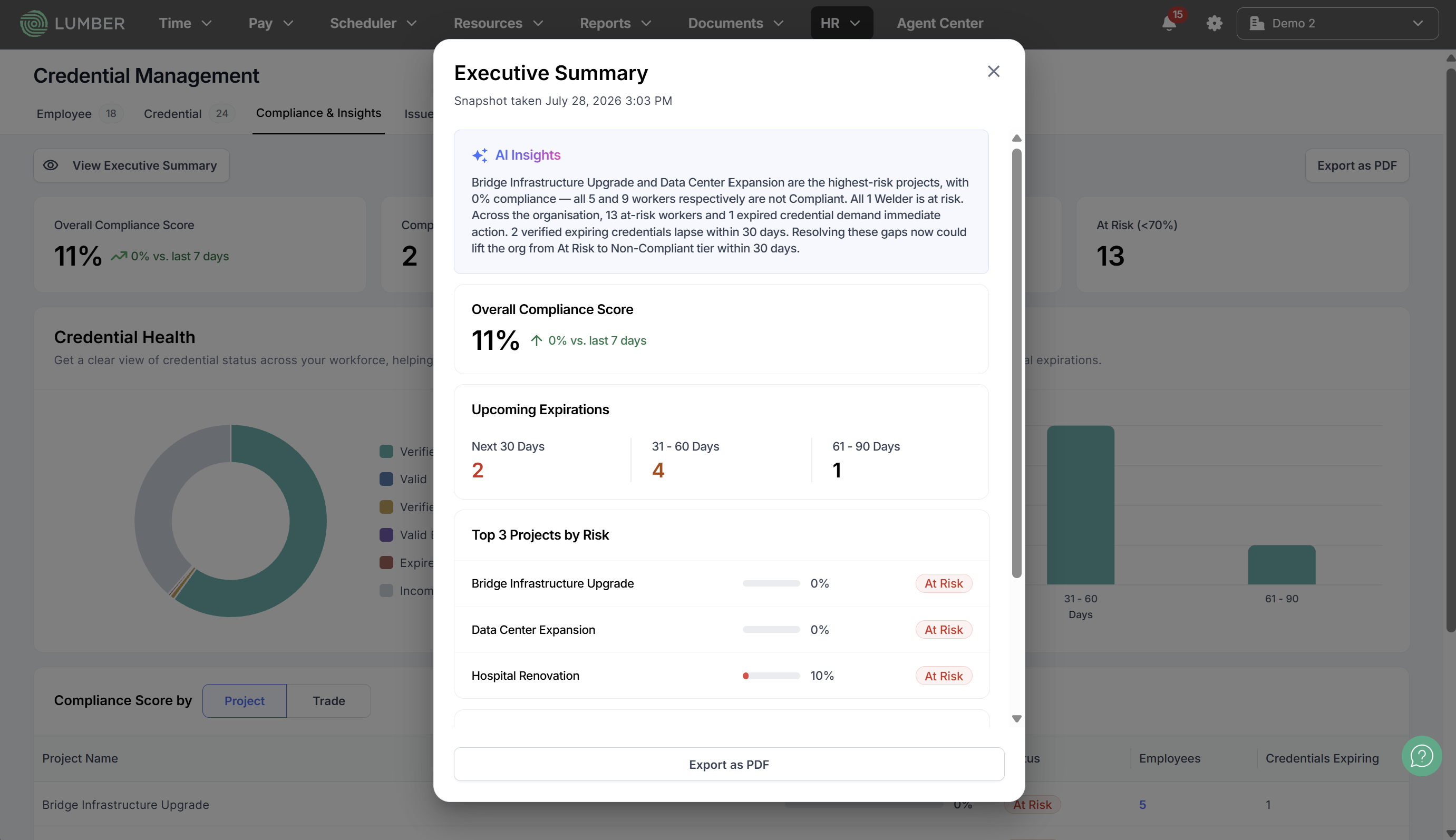
- Compliance tracking: Via the BuilderFax integration with Lumber, employers have a credential dashboard that covers certifications, licenses, union and trade memberships, and education, with reminders for expiring credentials and missing documents.
- Workforce visibility: Employers can assign training and see the credential gaps across crews and projects.
- Audit-ready documentation: Reports can be generated for sharing with project managers, auditors or compliance teams.
As workers own their records, the credentials move with them from employer to employer and project to project. EPCs collect less at each mobilization, and workers have a portable record of their credentials for their next opportunity.
Final Thoughts
At 5,000+ workers, credential issues result from hundreds of small gaps rather than one massive failure. Workforce credential management is about closing those gaps by keeping all records in one place, validating them, and tracking them right up to the point of expiry. The outcome is crews qualified before they even reach the gate, with records ready when required.
Useful Resources
Frequently Asked Questions
What is workforce credential management?


Why is workforce credential management important?
How do the EPC firms manage their workforce credentials?
What happens when worker certifications expire?
Can digital workforce credentials improve compliance?
Know Who’s Qualified Before They Reach the Gate
Workers carry their certifications in a free BuilderFax wallet, and your team tracks expirations across every crew from one dashboard. NCCER credentials sync automatically, so mobilizations start with less paperwork.
Download BuilderFax