

How to Verify Every Worker On-Site Is Actually Qualified, Including Subcontractors

How to verify worker qualitfications?
To verify worker qualifications on-site, list the credentials each task requires on your project. Then confirm each credential with the issuing organization and verify it's current for your jurisdiction. Finally, document any required employer training or evaluation. Apply the same process to every subcontractor and lower-tier worker, and repeat it when crews or tasks change.
At a Glance
- OSHA 10 and OSHA 30 cards come from a voluntary training program. OSHA says they are not a certification or license, and they have no federal expiration date.
- OSHA does not verify individual cards. The QR code on a plastic card gives contact details for the training center that processed it.
- Local rules can be stricter. NYC Site Safety Training (SST) cards are valid for five years, and OSHA training only counts toward them if it was completed within the past five years.
- A credential alone does not always make a worker qualified for a task. Crane operators, for example, need a documented employer evaluation in addition to certification.
- A general contractor that qualifies as a controlling employer may be cited for subcontractor-related hazards if it fails to exercise reasonable care.
- OSHA's 2026 maximum federal penalties are $16,550 per serious violation and $165,514 per willful or repeated violation.
Why On-Site Verification Matters More Than Ever

On-site construction compliance must be continuous. Crews rotate, subcontractors bring in new workers, and credentials lapse after hiring.
Three questions get confused on most jobsites:
- Does the worker have a credential?
- Is that credential authentic and current?
- Is the worker qualified for the specific task they're doing?
All three need a yes.
Some requirements are broad. OSHA's construction standards, for example, require employers to permit only workers qualified by training or experience to operate equipment and machinery (29 CFR 1926.20(b)(4)). Other requirements come from specific OSHA standards, state and local laws, and project specifications.
Gaps in any of these can lead to injuries, failed inspections, stop-work orders, and rework. They can also bring citations. OSHA's maximum penalties are $16,550 per serious violation and $165,514 per willful or repeated violation, although actual amounts depend on how the violation is classified and on penalty adjustments.
The Most Common Qualification Gaps on Active Job Sites
The most common gaps are training that doesn't meet local rules, missing task-specific qualifications, credentials that can't be verified, and subcontractor workers who were never checked individually.
Training that doesn't meet local rules. Federal OSHA Outreach cards don't expire, but some cities and project owners set their own rules. New York City is a good example:
- Workers on covered sites need an SST card.
- OSHA 10 or 30 training only counts toward that card if it was completed within the past five years.
- SST cards are valid for five years.
- Under a 2026 rule change, workers can renew up to one year after expiration, but an expired card cannot be used on-site until it's renewed.
Missing task-specific qualifications. An OSHA 10 card shows that a worker completed general hazard awareness training. It doesn't satisfy OSHA's training requirements for specific hazards. Those requirements depend on the standard: some call for training, some for demonstrated competency, and some for certification or a documented employer evaluation.
Credentials you can't confirm. OSHA has no national database for verifying cards. Even credentials that look legitimate can be invalid. In September 2026, NYC's Department of Buildings invalidated every SST certificate issued by a course provider indicted for fraudulent card issuance. Affected workers were given until December 7, 2026, to retrain.
Where Subcontractor Verification Breaks Down
Subcontractor verification usually fails in predictable places:
- Prequalification checks the company, not the individual worker.
- Crews change without notice, so the worker who arrives may not be the one whose documents you reviewed.
- Lower-tier subcontractors never make it into the GC's records.
OSHA's Multi-Employer Citation Policy explains why this matters. A controlling employer, meaning one with general supervisory authority over the site, must exercise reasonable care to prevent and detect violations. That doesn't make the GC automatically liable for every subcontractor violation. But in one example from the policy, a GC repeatedly pointed out a painting subcontractor's fall protection violations and took no further action. OSHA found a citation to the GC appropriate because it had no graduated enforcement system.
Classification adds risk on prevailing wage work. On federal Davis-Bacon projects, a worker can be paid apprentice rates in two situations:
- They are individually registered in a registered apprenticeship program.
- They are in their first 90 days of probationary employment and have been properly certified as eligible.
Apprentice-to-journeyworker ratios also apply. A worker who doesn't meet these conditions generally must be paid the full prevailing wage for the work they perform.
Beyond OSHA: Other Credentials You Need to Verify
OSHA cards are only one part of a worker’s qualifications. Trade certifications, licenses, and employer-issued authorizations each come from a different source, and each has its own validity rules, so you need to verify each one separately.
On-Site Verification vs. Contractor Vetting: What's the Difference?
Contractor vetting decides whether a company is fit to hire. On-site verification confirms that each worker is qualified for the task they're doing today.
How to Verify Worker Qualifications on Site (Step-by-Step)
Define requirements, collect credentials early, confirm them at the source, match them to tasks, and don't assign work until you resolve gaps.
1. Define requirements by task. Pull them from OSHA standards, state and local rules, owner specifications, and your contract.
2. Collect credentials before mobilization. Require subcontractors to submit credentials for each named worker, including lower-tier workers.
3. Verify at the source. This is the core of OSHA training verification:
- For plastic OSHA cards, scan the QR code to get the contact details of the OTI Education Center that processed the card, then contact the center.
- For paper cards, get the authorized trainer's details. Trainers must keep training records for five years.
- For licenses and certifications, use the issuing body's lookup tool.
4. Check currency and jurisdiction. Confirm each credential is valid where the work is happening.
5. Match credentials to the task. Crane certifications, for example, are issued by equipment type and capacity. Employers must also evaluate operators on the equipment and work they'll be assigned, and keep that documentation available at the worksite.
6. Hold unverified workers back. If you can't verify a credential, don't assign the worker to tasks that require it until you resolve the issue.
7. Confirm identity at check-in. Make sure the person on site matches the credential holder.
8. Re-verify when things change. Recheck when crews, tasks, or subcontractors change; this is a strong practice, even where no regulation requires it.
A Practical On-Site Compliance Checklist
- Credential requirements are defined for each task on this project.
- List every worker by name, including subcontractor and lower-tier workers.
- Each credential's issuer and verification date are recorded.
- Credentials are current and valid for this jurisdiction.
- Employer training, competency assessments, and evaluations are documented separately from third-party certifications.
- Equipment operators have credentials matching the equipment they'll use.
- Apprentices on prevailing wage work are registered or certified as probationary.
- Workers with unverified credentials are kept off tasks that require them.
- Worker identity is confirmed at check-in.
- Upcoming expirations are tracked, and records are audit-ready.
How Onsite Compliance Software Enables Real-Time Verification
Onsite compliance software keeps credential records, verification status, and expiration dates in one place, so gaps show up before an inspection.
Software supports three distinct jobs:
- Collection: storing certificates, licenses, and training records.
- Verification: recording that you confirmed a credential with its issuer or another authoritative source.
- Monitoring: tracking expirations, missing documents, and assignment requirements.
Uploading a document does not authenticate it. You still need a verification procedure. What software adds is visibility and a consistent record.
How BuilderFax Helps You Verify Workers Faster
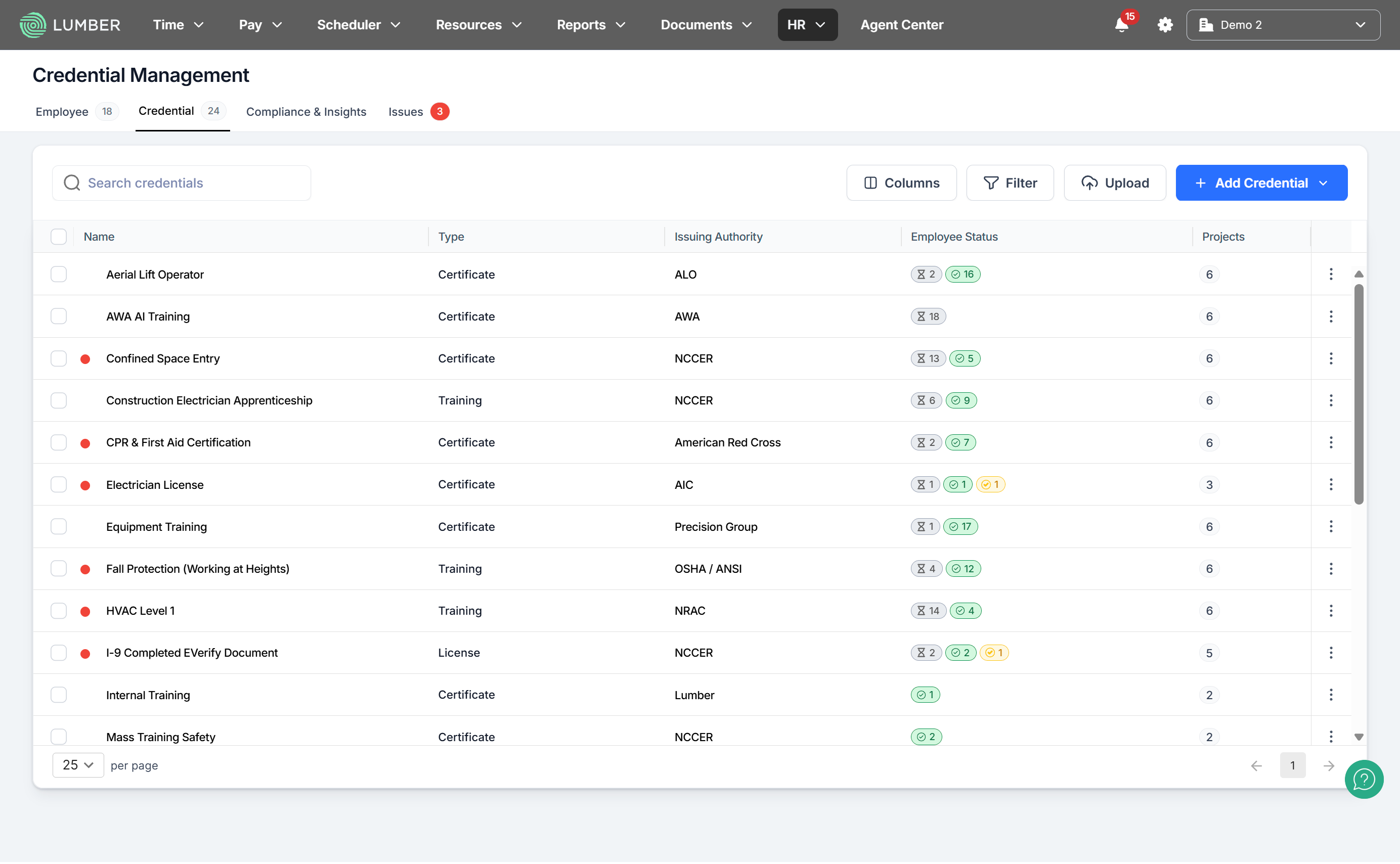
BuilderFax gives contractors one dashboard for workforce credentials, and it gives workers a digital wallet they carry from job to job.
For employers, BuilderFax offers the following:
- Compliance dashboard. Shows whether each credential is complete, verified, expiring, or expired, and lets you filter by role, project, or compliance status.
- Subcontractor tracking. Tracks subcontractor credentials alongside your direct workforce.
- Verified status. Lets admins mark credentials as verified after confirming them. Worker-added uploads stay locked from admin edits.
- Reminders. Sends renewal reminders for credentials that are expiring or expired. For assigned credentials, automated reminders go out at 5, 10, 15, and 30 days.
For workers, BuilderFax is free. Workers can store credentials, share credentials published by participating Credential Partners, and log their work history. BuilderFax is also NCCER's official digital wallet. For contractors, this means fewer lost documents. For workers, it means a professional record that stays with them throughout their career.
Final Thoughts
Having a credential, verifying it, and being qualified for a task are three different things. Contractors need all three, for every worker on site, including subcontractor and lower-tier crews. Because crews, tasks, and rules keep changing, verification has to continue throughout the project. A checklist tells you what to check, and a system keeps those checks current so you stay compliant and audit-ready.
Useful Resources
- OSHA Outreach Training Program FAQs
- OSHA: The Facts About Obtaining an OSHA Card
- OSHA Directive CPL 02-00-124: Multi-Employer Citation Policy
- 29 CFR 1926.1427: Crane Operator Training, Certification, and Evaluation
- OSHA Publication 2254: Training Requirements in OSHA Standards (PDF)
- OSHA Penalties
- NYC DOB SST Information
- DOL Davis-Bacon Compliance Principles
Frequently Asked Questions
How do you verify worker qualifications on a construction site?


What is the difference between contractor vetting and on-site verification?
How do you verify OSHA training for workers on-site?
Why is subcontractor verification important for compliance?
What is an on-site compliance checklist?
How does on-site compliance software improve verification?
Can you verify worker qualifications without physical paperwork?
Know Who's Qualified Before They Reach the Gate
BuilderFax puts your crew's and subcontractors' credentials in one dashboard, so you can see who is verified, expiring, or missing requirements. Automated renewal reminders help you catch lapses before they turn into compliance gaps.
Download Builderfax