

The Certification Gaps That Cause the Most Construction Site Incidents (and How to Close Them)

At a Glance
- On a jobsite, the construction skills gap shows up as workers doing tasks they cannot prove they are trained, certified, or licensed for.
- ABC estimates the industry needs about 349,000 net new workers in 2026, with retirements driving most of that demand.
- Falls caused 389 of 1,034 private construction deaths in 2024, and fall protection training ranked among OSHA's 10 most cited standards in FY 2025.
- High-risk gaps include missing fall protection training records, expired crane operator certifications, missing state-required safety training, lapsed licenses, and unverified subcontractor credentials.
- In 2026, OSHA penalties can reach $16,550 per serious violation and $165,514 per willful or repeated violation.
Quick Answer
The certification gaps most closely tied to construction site incidents involve the hazards that hurt the most workers: falls, ladders, scaffolds, and cranes. In practice, that means missing or undocumented fall protection training, expired crane operator certification, and credentials nobody verified before work started. Contractors close these gaps by keeping every credential in one current system, verifying records before mobilization, and automatically tracking expirations.
Introduction
A new hire tells the foreman he's fall-protection trained, and he goes up on the roof that afternoon. Nobody checks. Weeks later, an OSHA compliance officer asks for his training record, and there isn't one.
That is how the construction skills gap usually looks on a jobsite. It is rarely a dramatic failure. It is a missing record, an expired card, or a credential no one confirmed. This guide covers the certification gaps most connected to serious incidents and citations, why they keep happening, and how contractors can close them.
What the Construction Skills Gap Means on Job Sites Today
On site, the construction skills gap is the distance between the qualifications a task requires and the qualifications your crew can actually prove.
The construction skilled-labor shortage makes that gap harder to manage. Associated Builders and Contractors (ABC) estimates the industry must attract about 349,000 net new workers in 2026 and 456,000 in 2027. ABC's chief economist noted that most of the 2026 demand comes from retirements, not new growth.
When experienced workers retire, crews get newer. Newer workers need more training, and higher turnover means credential records go stale faster. The skills gap in the construction industry is therefore also a documentation gap.
That matters for safety because training requirements exist for the highest-risk work. According to the Bureau of Labor Statistics, falls, slips, and trips caused 389 of the 1,034 private construction deaths in 2024, and construction accounted for almost half of all fatal falls in private industry.
The Most Common Certification Gaps Behind Site Incidents
The most common gaps involve fall protection training, crane operator certification, state-required safety training, lapsed licenses, and unverified credentials.
No national dataset ranks site incidents by credential type. OSHA's citation data is the clearest public signal of where requirements are missed. In fiscal year 2025, OSHA's top 10 most cited standards included fall protection general requirements (first), ladders (third), scaffolding (sixth), and fall protection training (seventh). Fall protection training alone accounted for 1,907 violations.
The consequences stack up quickly: injuries, stop-work orders, schedule delays, and penalties. OSHA's 2026 maximums are $16,550 per serious violation and $165,514 per willful or repeated violation, assessed per violation.
A quick terminology note: certifications, training records, and licenses are different things. OSHA 10 and OSHA 30 are training programs. OSHA states that its Outreach card is not a certification or license.
High-Risk Gaps to Watch
Why These Gaps Persist in the Construction Industry
Gaps persist because most credential tracking is still manual, scattered across systems, and checked only when an inspection or audit is coming.
Common causes include:
- Spreadsheets that age instantly. A tracker is only as current as the last person who updated it, and crews change weekly.
- Paper that disappears. Cards get lost, damaged, or left in a truck. Photocopies are hard to verify.
- Fragmented systems. HR, safety, payroll, and project teams often keep separate records that never match.
- Different expiration rules. Federal OSHA Outreach cards do not expire, crane operator certifications last five years, and license cycles vary by jurisdiction. One generic tracking rule does not fit.
- Limited subcontractor visibility. General contractors often see subcontractor credentials only when something goes wrong.
- Reactive habits. Records get reviewed before an audit, not before a worker starts a task.
These are process problems, not people problems, which is good news: process problems can be fixed.
How Automation Helps Close the Workforce Skills Gap
Automation cannot train workers, but it removes the human error that lets missing or expired credentials slip through.
Here is how automation addresses the skills gap in the workforce in practical terms:
- One source of truth. Every credential lives in one record instead of five spreadsheets.
- Alerts before expiration. Renewal reminders go out ahead of time, not after a lapse.
- Assignments with deadlines. A safety manager can assign required training before a project starts and let reminders handle the follow-up.
- Verification status. Teams can see which records have been confirmed and which are only self-reported.
- Gap visibility by role and project. Contractors can spot which trades or crews are missing credentials and direct training budgets there.
The outcome is a shift from reactive compliance to continuous readiness: records are current when a worker is assigned, not just when an inspector arrives. Workers benefit too. A portable, organized record makes it easier to prove qualifications when moving between employers or projects, helping shrink the construction trades skills gap from both sides.
How BuilderFax Helps Contractors Stay Job-Ready
BuilderFax gives contractors and workers one place to store, verify, track, and share construction credentials.
Store and manage credentials in one place. The BuilderFax employer dashboard shows each employee's credential status as complete, verified, expiring, or expired, and lets you filter by role, department, project, or compliance status. It supports certifications, licenses, training completions, and custom credential types, and covers subcontractors alongside direct employees.
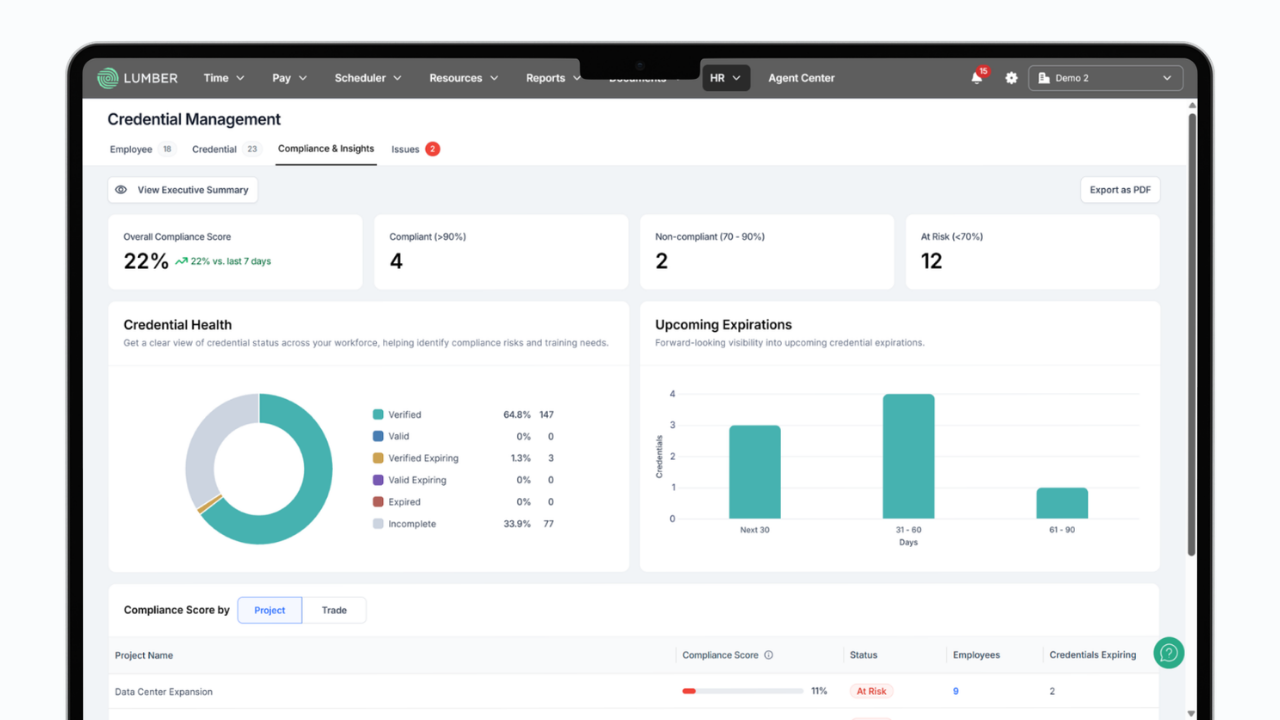
Share verified credentials. Workers can use the free BuilderFax app for individuals to store and share verified credentials from participating Credential Partners. BuilderFax is the official digital wallet for NCCER. Employers can also mark credentials as verified after confirmation, and worker-added uploads stay locked from admin edits.
Stay ahead of expirations. Admins can trigger renewal reminders manually or set them to run automatically for expiring or expired credentials. When admins assign a credential with a deadline, reminders go out at 5, 10, 15, and 30 days after assignment.
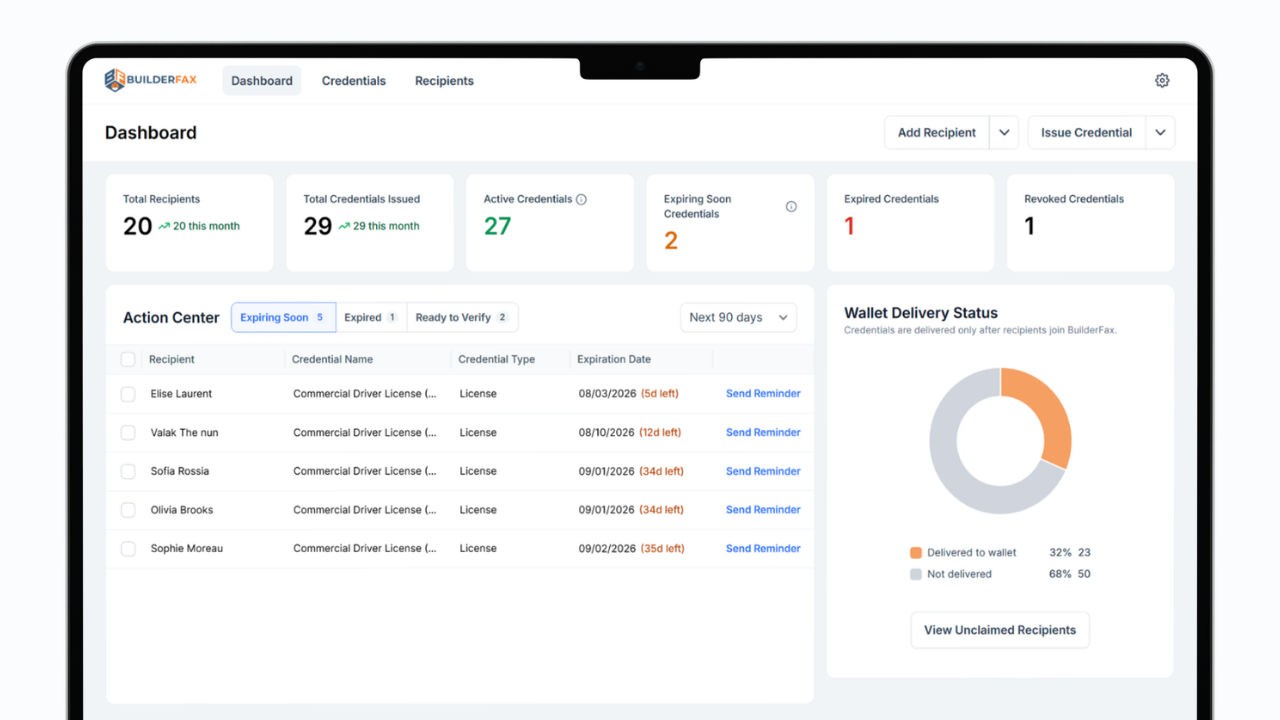
For workers, BuilderFax also supports logging work history, which turns a stack of cards into a career record they control.
Final Thoughts
Most certification gaps are preventable. Workers may be qualified, but if no one can prove it, or if a credential quietly expires, the risk still lands on the jobsite. Contractors who treat credential tracking as a continuous process, not a pre-audit scramble, are better positioned to keep crews safe, avoid citations, and keep projects moving.
Useful Resources
- OSHA Top 10 Most Frequently Cited Standards
- OSHA 29 CFR 1926.503, Fall Protection Training Requirements
- 29 CFR 1926.1427, Crane Operator Training, Certification, and Evaluation (Cornell LII)
- OSHA Outreach Training Program FAQs
- OSHA Penalties
- BLS, National Safety Stand-Down Highlights Fall Hazards in Construction
- ABC Construction Workforce Shortage
Frequently Asked Questions
What is the construction skills gap?


How do certification gaps cause construction site incidents?
What are the most common certification gaps in construction?
How can contractors address workforce skills gaps effectively?
What role does automation play in closing the skills gap?
How can construction teams prevent certification gaps?
Close Certification Gaps Before They Reach the Jobsite
BuilderFax gives contractors one dashboard to see which credentials are verified, expiring, or missing across employees and subcontractors. Automated renewal reminders and credential assignments help your crews stay qualified for the work ahead.
Download BuilderFax