
Welder Career Path: From Entry-Level Welder to AWS Certified Welder to CWI

At a Glance
- The AWS Certified Welder (CW) credential is performance-based: there are no required courses, prior certifications, or minimum years of experience to test.
- CWI (Certified Welding Inspector) eligibility is based on a combination of education and documented welding-based work experience, not on holding a CW certification.
- AWS does not list CW certification as a formal prerequisite for CWI. The two credentials serve different purposes: CW verifies hands-on welding skill, CWI verifies inspection knowledge.
- The CWI exam has three parts (Fundamentals, Practical, Code Book), each requiring a minimum score of 72%.
- CW certification stays active through periodic continuity documentation rather than a fixed expiration date, tracked through AWS's WeldCert Pro system. CWI certification runs on a nine-year cycle with renewal steps at years three and six.
Introduction

Many welders think about their career in stages: learn the trade, get certified as a welder, then eventually move into inspection. That instinct is reasonable, but it is worth being precise about what each step actually requires.
The AWS Certified Welder (CW) credential and the AWS Certified Welding Inspector (CWI) credential are both issued by the American Welding Society, but they are independent programs with separate eligibility rules, separate exams, and separate purposes.
Understanding how each one actually works, rather than assuming one leads directly into the other, makes it easier to plan a realistic timeline and avoid spending time on documentation that will not actually count toward the next credential.
Stage 1: Entry-Level Welding
Most welders start by building hands-on skill through some combination of vocational or technical school, an apprenticeship, military training, or on-the-job learning under a more experienced welder. These are common routes into the trade, not formal AWS requirements.
What matters at this stage is developing the ability to consistently produce a weld that meets a defined Welding Procedure Specification (WPS), along with the judgment to work safely around the hazards specific to welding.
During this period, welders typically:
- Learn core processes such as SMAW, GMAW, FCAW, or GTAW, depending on their industry
- Practice reading welding symbols and following WPS documentation
- Build the positional and material-specific skills needed for structural, pipe, sheet metal, or pressure vessel work
- Develop safe work habits around common welding hazards, including arc radiation, fumes and gases, electrical shock, burns, and fire risk, along with proper use of personal protective equipment and ventilation
- Accumulate documented work experience, which becomes relevant later for CWI eligibility
There is no single AWS certification that every entry-level welder must hold. What welders accumulate at this stage is practical skill and, importantly, a documented work history. Keeping a simple, ongoing record of employers, dates, processes used, and positions worked pays off later, since welding-based work experience is one of the two pillars AWS uses to determine CWI eligibility, and gaps in documentation can slow down a future application.
Stage 2: AWS Certified Welder (CW)
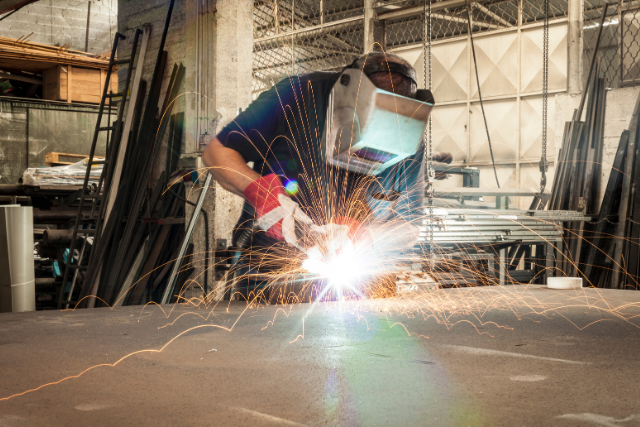
The Certified Welder program is where many welders formally demonstrate their skills to an outside standard. According to AWS, the program is strictly performance-based, with no prerequisite courses or certifications required.
If a welder can produce the weld required by the test, they are eligible to test. AWS notes that welders may qualify through a variety of backgrounds, including welding school, apprenticeship, military experience, technical college, or on-the-job experience, which makes the program accessible regardless of how someone learned the trade.
How it works:
- Contact an AWS Accredited Testing Facility (ATF) and schedule a welder performance qualification test.
- Weld according to a specified Welding Procedure Specification, covering fit-up, assembly, and positioning as required by the test.
- An AWS Certified Welding Inspector (CWI) at the ATF evaluates the completed weld against the applicable code or standard.
- If the weld passes, the ATF forwards the application, test results, and fee to AWS for certification.
CW testing covers procedures used in structural steel, petroleum pipelines, sheet metal, chemical refinery welding, and pressure vessel work, and some ATFs also test to a company-specific or non-code procedure. Testing fees are set by the individual ATF rather than by AWS directly, so candidates should confirm current pricing with their chosen facility. If a welder does not pass on the first attempt, AWS allows retesting, and there is no limit on the number of attempts.
One practical advantage of CW certification is portability. Because it is based on nationally and internationally recognized welding standards rather than tied to a single employer or project, the credential is intended to be recognized wherever the underlying qualification is accepted, and AWS maintains a National Registry of Certified Welders that employers can use to verify an individual's status. This can matter for welders who relocate or who want documentation that travels with them between jobs.
Once certified, a CW credential does not expire on a fixed multi-year timeline. AWS states that certification remains valid as long as continuity is maintained, and its current CW program page specifies that maintenance documentation must be submitted every six months confirming the welder is still performing the certified process; the specific interval is ultimately governed by the applicable code.
Welders now manage this through AWS WeldCert Pro, an online continuity log AWS launched in November 2025 as part of its QC47 specification update, replacing the earlier paper-based maintenance process. Missing continuity can result in the certification going inactive, which may require requalifying through testing.
On the question of whether CW certification is worth pursuing, AWS's own position is appropriately measured: certification does not guarantee a specific salary or job outcome, but it can help demonstrate that a welder has met established industry standards, which employers in fabrication, manufacturing, construction, and energy commonly look for when hiring. Any salary information a welder finds while researching the trade describes the broader job market, not a specific outcome that certification promises.
Stage 3: Certified Welding Inspector (CWI)
This is where the "pathway" framing needs a correction. AWS does not list AWS Certified Welder (CW) status as a requirement, substitute, or shortcut for CWI eligibility. CWI eligibility runs on a defined combination of education and welding-based work experience, shown below exactly as AWS publishes it.
Candidates must also pass a vision test as part of the initial application, and AWS requires supporting documentation such as employment verification forms to confirm the work experience claimed on the application.
The CWI exam has three parts, each requiring a minimum score of 72%:
- Part A, Fundamentals: 150 questions covering destructive testing, fabrication math, safety, metallurgy, nondestructive testing, welding symbols, WPS/PQR concepts, and general welding fundamentals. Administered via computer-based testing at Prometric centers.
- Part B, Practical: Hands-on activities using AWS-provided equipment, plus 46 related questions, covering application of WPSs and PQRs, use of inspection tools, and execution of required welds. Administered at AWS seminar locations.
- Part C, Code Book: An open-book exam of 50 to 65 questions testing the candidate's ability to locate and apply information in a permitted code book, such as AWS D1.1, API 1104, AWS D1.2, AWS D1.5, AWS D15.1, AWS D17.1, or relevant ASME BPVC sections.
Candidates must complete Part B before taking Parts A and C. Once someone is CWI certified, AWS also offers a catalog of endorsements that let inspectors document additional, specialized knowledge beyond the base credential, covering areas such as structural steel, structural aluminum, bridge welding, railroad, aerospace, pipeline inspection under API 1104, magnetic particle and penetrant testing, ASME BPVC Section IX and related piping codes, ISO standards, and welding coordination and quality assurance. These endorsements are optional and are typically pursued after CWI certification, as a way to build a more specialized inspection career rather than as part of initial eligibility.
Why the CW-to-CWI Connection Still Makes Sense in Practice

Even though CW is not an official prerequisite, the two credentials often appear together in a welder's career for a practical reason: CW certification demonstrates hands-on welding ability and can strengthen a welder's professional profile, while continuing to work in the trade builds the years of welding-based work experience that CWI eligibility actually requires. It's important to keep these two things separate.
The CW credential itself does not replace or substitute for the work-experience documentation AWS requires for CWI, such as employment verification and additional qualifying work experience forms. Welders planning toward CWI should maintain their own separate, ongoing records of qualifying welding-based employment and education alongside any certifications they earn, since a testing credential and an experience record serve different functions in an AWS application.
Maintaining and Renewing These Credentials
CW: Remains active through continuity documentation submitted via AWS WeldCert Pro, with AWS's current CW program page specifying a six-month maintenance interval, subject to the requirements of the governing code. There is no fixed multi-year expiration as long as continuity requirements are met, which makes CW a credential welders can carry indefinitely with routine upkeep rather than a repeated retesting cycle.
CWI: Valid for nine years from initial activation. Renewal applications are required at years three and six, confirming no break in practice or employment exceeding two years within the prior three years. Renewal applications can be submitted as early as eleven months before expiration, and AWS recommends applying at least sixty days ahead of the deadline. At the nine-year mark, CWIs must recertify through an approved pathway, such as the Part B practical exam, 80 Professional Development Hours of continuing education, an eligible endorsement exam, or initial AWS Certified Radiographic Interpreter (CRI) certification.
A welding career often does move from entry-level work, to CW certification, toward inspection-focused roles over time, but that progression happens because welders are building real skill and documented experience along the way, not because AWS treats CW as a required stepping stone to CWI.
Welders planning toward CWI should track their education and welding-based work experience carefully against AWS's published eligibility table, since that documentation, not a specific prior certification, is what determines when they are eligible to apply.
Useful Resources
Frequently Asked Questions
Does becoming AWS Certified Welder (CW) count toward CWI experience requirements?

.svg)
Can someone go straight from entry-level welding to CWI without ever earning CW certification?
How long does it typically take to become CW certified?
Is CWI harder to qualify for than CW?
Keep Every Certification Ready for the Next Step
BuilderFax gives welders a single place to store CW certifications, employment records, and other credentials as they build toward CWI eligibility, with reminders for certification continuity and renewal deadlines. That makes it easier to keep the documentation an employer or AWS application actually needs on hand.
Download BuilderFax.svg)
.svg)